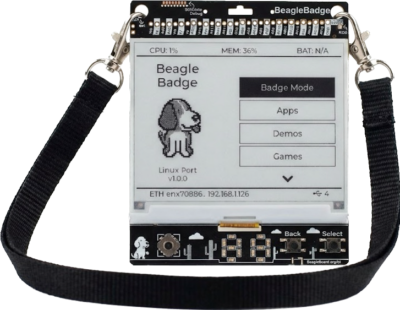




BeagleBadge

Purchase
at

BeagleBadge brings a new vision to wearables by combining powerful built-in sensing with unmatched expansion flexibility. With an onboard light sensor, accelerometer/gyroscope for precise position and orientation feedback, and integrated temperature and humidity monitoring, it empowers users to design intuitive, context-aware interactions. Beyond its core features, dual QWIIC, Grove, and mikroBUS headers unlock thousands of additional sensors and actuators— from pulse oximeters and UV spectroscopy to fingerprint readers, GPS, haptics, and audio. This extraordinary modularity transforms BeagleBadge into a limitless innovation platform, enabling rapid prototyping, research, and real-world solutions in health, environment, and human-machine interfaces. It inspires creativity while remaining practical, scalable, and accessible to all.

Chipset Features

Texas Instruments AM62L Sitara™ SoC

  • Dual-core 64-bit Arm® Cortex-A53 microprocessor subsystem at up to 1.25 GHz
    • Dual Cortex-A53 cluster with 256KB L2 cache
    • Each A53 core includes 32KB L1 instruction cache and 32KB L1 data cache
  • 160KB on-chip SRAM
  • DDR memory subsystem
    • Supports LPDDR4 or DDR4
    • 16-bit memory interface
    • Up to 1600 MT/s memory speed
  • Display subsystem
    • Single display up to 1920×1080 @ 60 fps
    • MIPI DSI (4-lane) or DPI (24-bit RGB) output
  • Integrated security subsystem
    • Secure boot with hardware root-of-trust
    • Arm® TrustZone® Trusted Execution Environment (TEE)
    • Hardware cryptographic acceleration (AES, SHA-2, RSA/ECC assist)
  • Networking and high-speed interfaces
    • Integrated Ethernet switch with RMII or RGMII
    • IEEE-1588 time synchronization support
    • Two USB 2.0 dual-role device ports
  • Connectivity peripherals
    • Up to 8× UART
    • 4× SPI
    • 5× I²C
    • 3× CAN with optional CAN-FD
  • Multimedia and analog
    • 3× McASP audio interfaces
    • 12-bit ADC with up to 4 multiplexed inputs
  • Storage interfaces
    • 1× eMMC (HS200)
    • 2× SD/SDIO (UHS-I)
    • OSPI/QSPI for serial NOR/NAND
  • Power management
    • Dynamic voltage and frequency scaling
    • Multiple low-power modes including standby and deep sleep

Texas Instruments CC3301 Wireless Connectivity IC

* 2.4-GHz IEEE 802.11 b/g/n Wi-Fi 4
* Bluetooth® Low Energy 5.3
* Integrated TCP/IP offload and networking stack
* Supports station, access point, and Wi-Fi Direct modes
* SPI host interface
* Integrated power management optimized for low-power IoT devices
* Coexistence support for simultaneous Wi-Fi and Bluetooth operation

Board Features

Hardware

  • Processor and memory
    • **NEW** TI AM62L32
      • Low-power SoC with display for IOT, HMI and general purpose applications
      • Dual-core Arm® Cortex®-A53 processor @ 1.25GHz
    • RAM: 2Gb (128M x 16bit)-1600MHz 3200Mbps LPDDR4
    • Flash/non-volatile:
      • 4GB eMMC storage
      • 256Mb OSPI flash
      • 32Kb EEPROM
  • Networking
    • BeagleMod CC3301-1216 Module, WiFi6 (2.4GHz) + Bluetooth 5.2 with MHF4 Connector
    • LoRaWAN (Wio SX1262 module) with u.FL Connector
  • Built-in Sensors
    • 1× IMU Sensor
    • 1× Ambient light sensor
    • 1× Temperature & humidity sensor
  • User interface
    • 1× Reset button
    • 1× 4-way Joystick button with press
    • 2× Tactile buttons (Back and Select)
    • 1× Passive Buzzer
    • 1× RGB status LED
    • 2× 7-segment LED displays
  • Battery interface
    • Battery management with fuel gauge monitoring
    • 1× BAT Connector for BL-5C
  • Expansion/connectors
    • Support 4.2″ ePaper via 24-pin FPC Connector
    • MIPI DSI connector for LCD displays
    • USB Type-C for Power input and debug
    • 1× mikroBus Connector
    • 1× USB2.0 Type-A host
    • 1× Micro-SD socket
    • 2× QWIIC Connector
    • 1× Grove Connector

Software

  • Linux and Zephyr base ports with mainline roadmap
  • LVGL and MicroPython libraries for interactive ePaper display
  • App store for programming examples
  • Meshtastic and ActivityPub integration for seamless off-grid messaging
Resources