
Wearable technology has traditionally been locked behind closed ecosystems, limiting how developers, students, and researchers can interact with and modify their devices. BeagleBoard.org is changing that narrative.
We are thrilled to introduce BeagleBadge, a limitless innovation platform that brings a new vision to wearables and low-power computing. By combining powerful built-in sensing with unmatched expansion flexibility, BeagleBadge serves as the perfect canvas for rapid prototyping, research, and real-world solutions in health, environmental monitoring, and human-machine interfaces.
BeagleBadge champions BeagleBoard.org Foundation’s core pillars of Access, Literacy, Ownership, and Longevity, empowering users to move from simply consuming technology to actively creating it. BeagleBadge provides access through a wearable design that can be easily experienced and understood by people of all skill levels. Literacy can be built through diving into novice to professional training built around PocketBeagle 2 and TechLab – allowing you to peel back the layers of the onion. Ownership is established with detailed open hardware design materials, individually sourceable parts, and software references. Longevity is maintained through Beagle’s on-going upstreaming and long-term production commitments.
Out-of-the-Box Power and Sensing
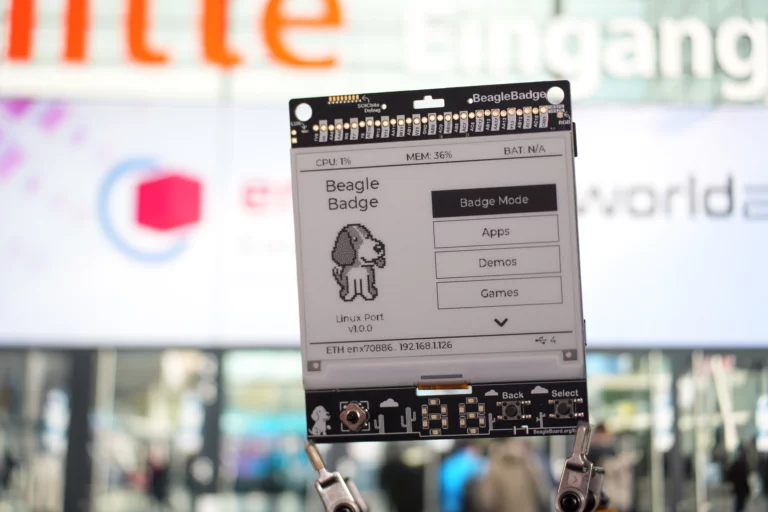
Right out of the box, BeagleBadge is designed to inspire creativity while remaining practical and accessible. It features a highly interactive 4.2″ (107mm) ePaper display with native Linux drivers, augmented by MicroPython and LVGL libraries.
To help you design intuitive, context-aware interactions immediately, BeagleBadge is loaded with built-in sensors and radios, including:
-
Wi-Fi 6 / BLE 5.4
-
LoRA Sub-GHz long-range connectivity
-
An accelerometer and gyroscope for precise position and orientation feedback.
-
Integrated temperature and humidity monitoring.
-
An ambient light sensor.
-
A rich user interface featuring a 4-way joystick, tactile buttons, a piezo buzzer, an RGB status LED, and dual 7-segment LED displays
.
Unmatched, Solder-Free Expansion
What truly sets BeagleBadge apart is its extraordinary modularity. You are not limited to the sensors that come on the board. BeagleBadge features dual QWIIC, Grove, and mikroBUS headers.
This means you can instantly plug in and unlock thousands of additional sensors and actuators—from pulse oximeters and UV spectroscopy to fingerprint readers, GPS, haptics, and audio modules—all without ever needing to pick up a soldering iron.
And as with all Beagles, the design is fully open-source hardware, freeing you to extend the design in any way that you can imagine.
Under the Hood
BeagleBadge packs serious computing power and connectivity into its pocket-sized, wearable footprint (110mm x 91mm):
-
Processor: Texas Instruments AM62L32 Dual-core Arm Cortex-A53 running at 1.25GHz.
-
Memory & Storage: 256MB of LPDDR4 RAM and 256Mb of OSPI flash.
-
Wireless Connectivity: Outfitted with a BeagleMod CC3301 module for Wi-Fi 6 (2.4GHz) and Bluetooth 5.2, plus support for LoRaWAN via a Wio SX1262 module.
-
Power: Integrated battery management with fuel gauge monitoring and a connector for a BL-5C Li-Ion battery.
Software That Empowers
BeagleBadge is supported by both Linux and Zephyr base ports, adhering to a mainline roadmap. To encourage exploration, it features an app store for programming examples and includes integrations for Meshtastic and ActivityPub, enabling seamless off-grid messaging right from your badge.
Whether you are a student learning to program your first IoT device or a professional engineering a complex, sensor-driven wearable for Embedded World 2026, BeagleBadge provides the open, inspectable infrastructure you need to bring your ideas to life.