
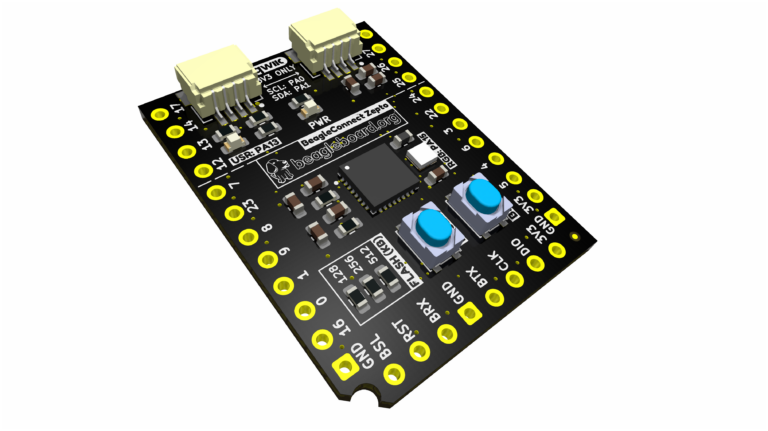
A few weeks ago, we gave out hundreds of BeagleConnect Zepto at Embedded World 2026. We also published the design files on Github.com and OpenBeagle.org.
So, what is Zepto?
BeagleConnect Zepto is based around a low-cost Texas Instruments MSPM0L1117 microcontroller that includes an Arm Cortex-M0 running at 32MHz, 128kB flash and 16kB of RAM. What I really like about it is:
- The friction-fit mikroBUS-compatible through-holes makes it possible to prototype with nearly 2,000 off-the-shelf sensor, actuator, indicator and networking “Click” add-on boards from mikroElektronika and many other board families compatible with the free-to-license mikroBUS standard and
- The low-cost microcontroller, 2-layer design and minimal connectors make it feasible for us to produce these boards under $1.
As a non-profit organization, we don’t have to be particularly worried about margin, but we do want to make sure to introduce something at a price where TI, PCB assemblers and distributors are happy with the margin they make that they’ll keep making it for us at about the same price for over 10 years. That’s a huge part of the magic of Beagle where we don’t want to compromise.
So, what can we do with a $1 computer that makes it actually worth $1 or more?
BeagleConnect, but QWIIC
In addition to the ability to add mikroBUS add-on boards, the 2 QWIIC connectors provide an ability to power and chain these boards to BeaglePlay, BeagleBadge, or other QWIIC-enabled host or target. So, while being able to control something locally is cool, connecting Zepto to Linux is easy, providing a path to greater coordination, Internet connectivity and the ability to prototype without writing new code using BeagleConnect Greybus for Zephyr. By exposing the peripherals of BeagleConnect Zepto to Linux over I2C a single Zephyr-based Greybus firmware load, no microcontroller firmware development is required to get your project off the ground. Linux already has driver support for over 200 mikroBUS add-on boards and support for more is being added all the time.
Topping it off with a HAT
Getting setup with a development environment for a new board can often be tricky. Going crazy with this friction-fit concept, one of the edges of the board is designed for HAT connectors like you find on Raspberry Pi or BeagleY-AI. The header provides for powering, resetting, programming and communicating with BeagleConnect Zepto. This allows for us to ship a complete development environment for BeagleConnect Zepto using BeagleBoard Imaging Utility. Our primary way of supporting software development on BeagleConnect Zepto is with the open source Zephyr RTOS and utilize the Arduino Core and Micropython support for Zephyr. Setting up this environment can sometimes be a challenge for new users, so exposing it through the VS Code Coder server makes it trivial to get up and running using one of these Linux hosts as your development environment.
Getting Involved
We are an open development community and this design was contributed by long-time community member and former GSoC intern Deepak Khatri of Upside Down Labs. Community contributions are the way BeagleBoard.org gets things done. For those looking to get involved, prototypes are available today. The primary way to get involved with Beagle is through our forum, but it is also possible to use Github.com and OpenBeagle.org to directly contribute to project repositories. We also have many community members on our various live-chat platforms including our Discord server that has over 3,000 members and our new Zulip server on OpenBeagle.org recently launched to provide an alternative that isn’t in a walled garden.
Currently, I’m working on a gaming environment that runs on BeagleBadge and uses BeagleConnect Zepto as the controllers, but I thought I’d pause for a few minutes to share this. I plan to eventually publish that on the BeagleBadge App Store Hackathon created by Andrei Aldea at TI when it is up and running.